Kasterwey
Although a good image takes time, organized trips, in the company of friends or for purposes other than those strictly photographic, are also an opportunity to take excellent shots. When you do tourism with more people, you will face the added challenge of not boring your companions, since you must be fast in the execution, without giving up for that to get suggestive shots. A versatile team, quick resources and some planning will mark your path to success.

Plan your visit

Whenever possible and you can influence the programming, try to visit the most photogenic places and do it at the best time of day, when the light is softer (early in the morning and late in the afternoon), although this is not always it will be possible for you. The frontal light is especially favorable for photos of buildings and architectural elements, which are usually a recurring motif in this type of photography - avoid the midday hours when the sun shines vertically. Before
To travel, take a look at the favorite blogs of travelers, such as www.viajeroerrante.com, which also has a good graphic contribution.

In this way, you will get ideas of the best places to visit in your destination and photographic inspiration. You will also find complementary information such as accommodation and gastronomy tips that are very useful to plan your trip.


Some locations are ideal for taking pictures during the blue hour, when it begins to get dark and the sky is a deep blue color, and the lights of street lamps and buildings already begin to turn on. A consultation of the events and festivities that take place during the date you visit the place can be, in addition to an interesting experience, a great photographic occasion. If you are one of those who likes to capture the sunrise and night photos, perhaps you can find a space while your companions sleep to revisit that location that you liked so much.

A light and versatile team

When the main objective of your trip is not photography, consider taking with you a very light equipment that does not bother you, but, above all, that is also versatile, since when it comes to sightseeing you will face many situations that require different techniques: monuments, landscapes, some portrait ...

Without a doubt, you will find the greatest freedom in a compact camera with manual functions. If you are going to opt for this option, try to make it of the highest possible quality, with updated technology that allows good noise management and that has a quality sensor and processor. It is important that it allows you to modify the essential parameters (aperture, speed and
ISO) and has aperture priority and speed modes.

If you have decided to opt for an advanced compact, then consider whether you prefer a model with greater versatility and a great
zoom or with better resolution and a bright optics, but with a smaller focal range. If in spite of everything you feel motivated and decide to travel with your SLR, take a versatile equipment where there is no shortage of an angle lens and a medium TV. A polarizing filter and a tripod are the two essential accessories. You can also add a set of gradient filters for twilight shots and an external flash. Mirrorless cameras are an intermediate alternative that gives you versatility and quality at the same time, with a good compromise regarding size and weight.

Time to take pictures

Once you have planned your visit and have your photography equipment for your tourist trip, it is time to face the moment of truth.

We are not going to deceive you, take interesting photos on the go, without being annoying to the rest of your companions and, in addition, enjoying the visit is a challenge. The main thing is that before each photographic situation you take a moment to evaluate the possibilities, decide if the scene is really worth it, what is the best angle from which you should take it and what
technical considerations you must take into account. Here are some of the situations that you may face and how to solve them:

I want to take a photo with a person in the foreground and a monument or landscape in the background, but the background is much brighter than the person in the foreground: In this situation it usually happens that the person comes out against the light, with a correctly exposed background and the model as a silhouette. This can be a very creative and interesting option, but if you are not looking for a backlight, take the correct exposure for the background and activate the flash integrated in the camera to give that extra contribution to the person. You will achieve a very effective shot where everything is correctly lit.

It is a very touristy place and there are too many people: You have two options. The first is to integrate people into your shot in a way that favors composition, that means patience and taking multiple takes. The second,
is to use a very long exposure time (15 or 30 seconds) to turn them into "ghosts" and make them disappear from your shot. For this you will need a tripod and most likely a neutral density filter.

I have arrived at the location at night or in the blue hour. The site is beautiful but the shot requires me to raise the ISO to a level where my camera loses a lot of quality: It is time to use a tripod. You will also see that the effect of people in motion is very flattering and that if you have water in the outlet (such as a waterfall or a lake) the result is even better.

I am inside a museum or a cathedral and there is not enough light: Open the diaphragm all the way and raise the ISO until the exposure is correct. You can not force the ISO so much and underexpose a point or two that then
you will recover in processing, if you shoot in RAW.

The contrast between the sky and the rest of the scene is excessive, so that the sky appears white, burned: If you master the HDR technique, this is the time to take three shots, with a couple of points of difference of
exposure (one correctly exposed, another underexposed and another overexposed) that you will then combine on the computer. Other options are: use gradient filters or the HDR function that many advanced compact cameras incorporate.

If you are not satisfied with any of the three solutions, expose so that you have as centered a histogram as possible without losing information on the far left or right. Although the visual result is not good, this will give you the possibility to correct the photo later in an editing program.

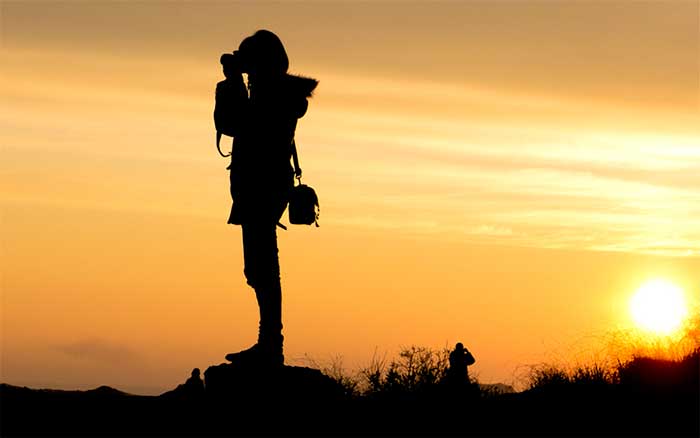
I am photographing the sunset: Take the opportunity to, in addition to taking out the colors of the sky and the sun, to achieve silhouettes against the light, for this, try to make the horizon as low as possible so as not to cut off the main motifs. If you want to get both planes well exposed you will need gradient filters.